Democrat Matt Mahan Knows It’s Time for An Era of Mass Treatment to Bring Everyone Indoors

Democrat Matt Mahan’s Plan to Implement Proposition 36 — Now

While Sacramento politicians retreated into partisan silos, Matt helped lead the campaign for Proposition 36, uniting Democrats, independents, and local officials across California behind a common-sense approach to accountability, social services integration, and treatment.

Californians overwhelmingly agreed, passing Proposition 36 with nearly 70% of the vote.

It is fair to say that Californians have had enough.

Well-intentioned policies to reduce incarceration have too often given way to rising overdose deaths, retail theft, and street homelessness. Voters are demanding a system that balances compassion with accountability — and delivers real results.

Right now, individuals in crisis who desperately need multiple public services are instead trapped in a fragmented and disconnected system.

In practice, it can be easier to remain on the streets than to navigate the maze of bureaucratic agencies required to receive care.

This lack of alignment — and failure to tie funding to measurable outcomes — has left billions spent without delivering results.

And for California residents, the impact is staggering:

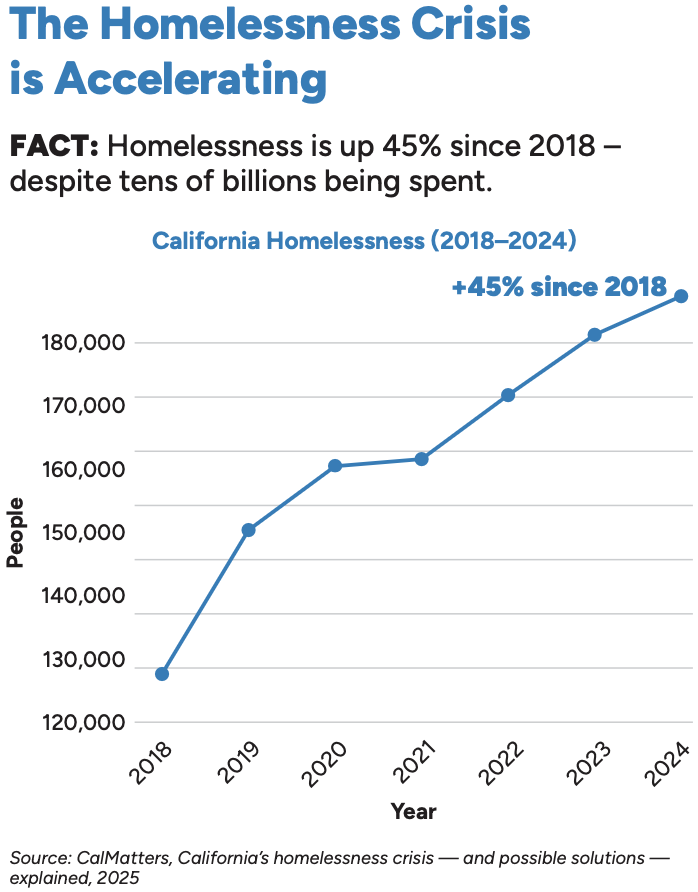
  • Since 2014, California has seen a sharp rise in homelessness, even as most other states have seen reductions. Today, more than 180,000 Californians are homeless, and nearly half struggle with substance abuse.

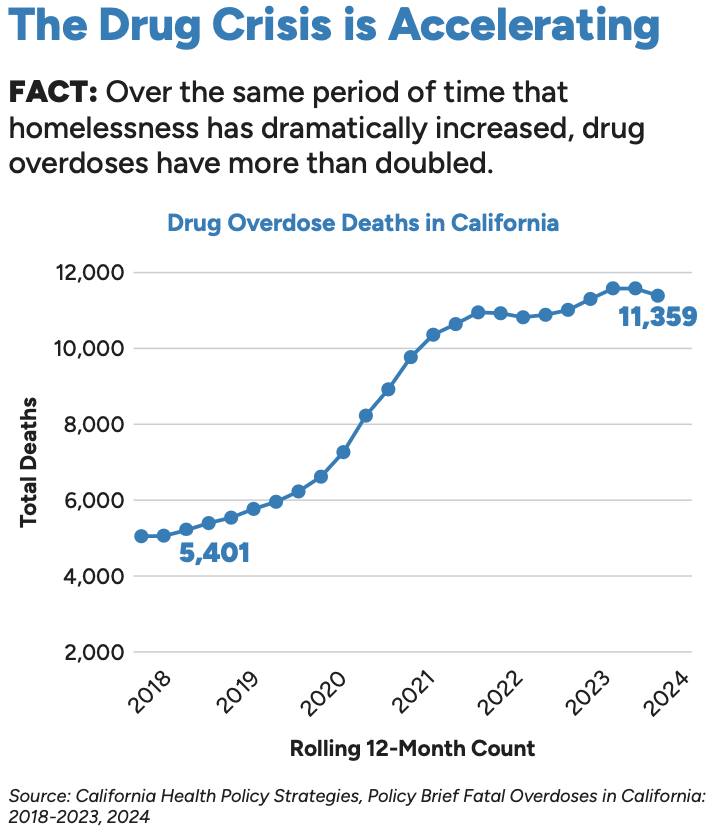
  • Fatal drug overdoses have surged, now claiming over 10,000 lives annually, and have become the leading cause of death for Californians under 45.

  • Drug overdose deaths in California have more than doubled, and homelessness has increased by about 45% since 2018.

  • Meanwhile, retail theft has imposed what many call a “theft tax” on working families — raising prices and forcing businesses to close or scale back operations.

  • On average, California spends over $50,000 per year per chronically homeless individual on emergency services, healthcare, and public safety.
Support Matt Mahan’s Plan to Implement Proposition 36

For Matt, this is Personal

When Matt was growing up, his cousin struggled with addiction. He sold his car for drug money and disappeared onto the streets. For years, his family lived with the fear of a late-night phone call telling them he hadn’t survived.

Eventually, his family intervened — forcing him into treatment and saving his life. Today, he is alive because someone stepped in when he could not help himself.

Not everyone has a family who can step in and save their life. But every Californian deserves a state that will.

In practice, it can be easier to remain on the streets than to navigate the maze of bureaucratic agencies required to receive care.

Delivering the Promise of Proposition 36

In 2014, California passed Proposition 47 to reduce incarceration for nonviolent offenses. While it succeeded in lowering the prison population, it also removed key tools that judges and prosecutors used to require treatment for repeat drug offenders and break cycles of addiction and crime.

Since reducing certain low-level drug possession and theft offenses via Proposition 47 in 2014, participation in California’s drug court programs has declined significantly, limiting one of the most effective tools for connecting people to treatment and social services to address major root causes of crime – poverty, mental health crises, and addiction.

Proposition 36 restores those tools. It allows judges to mandate treatment, strengthens accountability for repeat offenders, and targets fentanyl trafficking that is driving overdose deaths across the state.

True compassion means refusing to let our most vulnerable neighbors languish and die on our sidewalks while battling severe mental illness and addiction.

The nearly 70% of voters who passed Proposition 36 were clear: this is not about returning to mass incarceration — it is about building an era of mass treatment that combines accountability with real access to care, and meets people where they are while refusing to abandon them to the streets.

That’s why hundreds of local elected officials — including Democrats, independents, and leaders from California’s largest cities — came together to support Proposition 36. They see the consequences of inaction every day, and they know the status quo is failing.

But Sacramento still refuses to implement it. Matt Mahan will.
Proposition 36 restores those tools. It allows judges to mandate treatment, strengthens accountability for repeat offenders, and targets fentanyl trafficking that is driving overdose deaths across the state.

True compassion means refusing to let our most vulnerable neighbors languish and die on our sidewalks while battling severe mental illness and addiction.

The nearly 70% of voters who passed Proposition 36 were clear: this is not about returning to mass incarceration — it is about building an era of mass treatment that combines accountability with real access to care, and meets people where they are while refusing to abandon them to the streets.

That’s why hundreds of local elected officials — including Democrats, independents, and leaders from California’s largest cities — came together to support Proposition 36. They see the consequences of inaction every day, and they know the status quo is failing.

But Sacramento still refuses to implement it. Matt Mahan will.
The San Diego Model

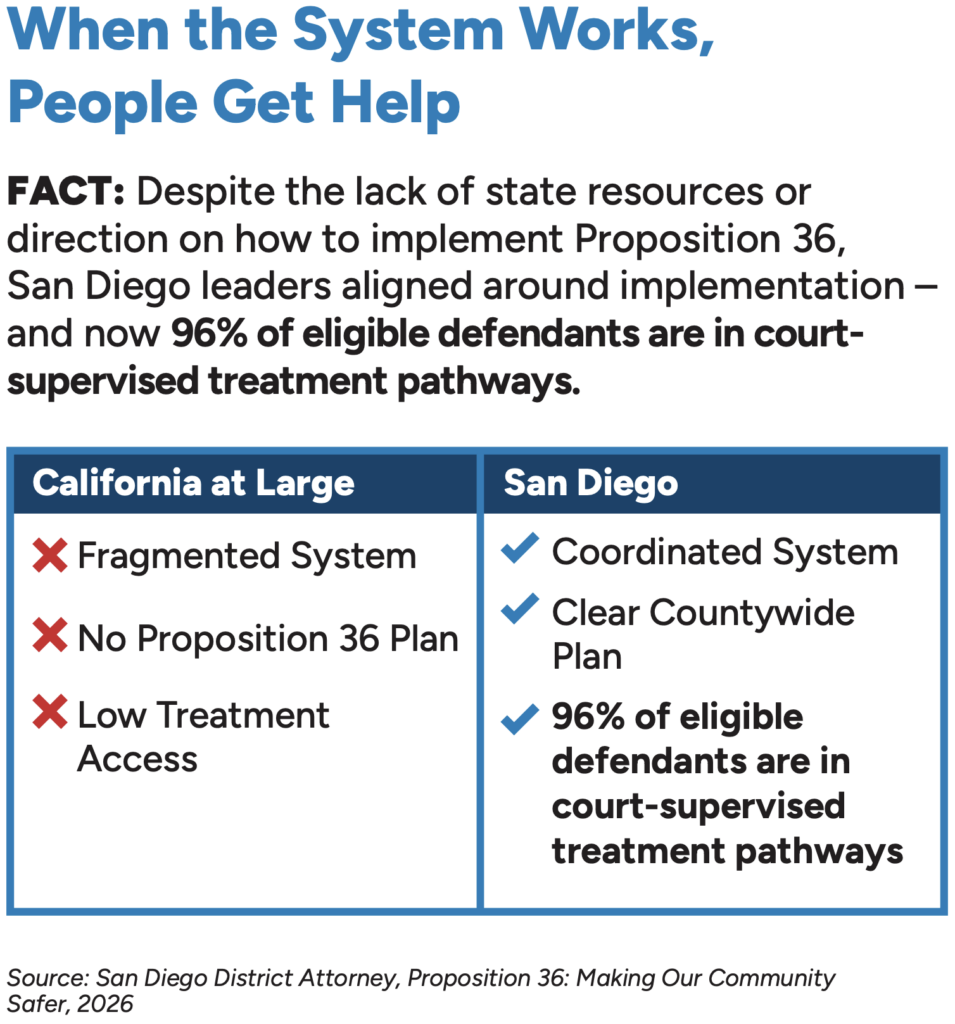
San Diego County has already shown that effective Proposition 36 implementation is possible. Despite limited state funding, local leaders aligned courts, law enforcement, and behavioral health providers around a shared goal: getting people into treatment. According to the San Diego District Attorney, over 96% of eligible defendants are now routed into treatment pathways through court-supervised programs — instead of cycling on and off the streets without intervention.

This progress was driven by strong coordination across local agencies, from prosecutors and local courts to public defenders and mental healthcare providers, to deliver results.

San Diego unified disconnected agencies around a shared goal of bringing people indoors, and overcame the hurdles of limited treatment capacity. While this collaborative effort proves that a human-centered approach to mandated treatment works, relying on locally patched-together resources is not sustainable.

Matt’s plan dedicates statewide funding to make this model scalable and effective across all of California.

San Diego County has already shown that effective Proposition 36 implementation is possible.

To fulfill the voters’ mandate and usher in an era of mass treatment, Matt Mahan’s comprehensive Proposition 36 platform focuses on building capacity, closing legal loopholes, and demanding strict county accountability.

Support Matt Mahan’s Plan to Implement Proposition 36

Here is His Plan

Matt Mahan’s Plan to Fully Implement Proposition 36

To deliver on the promise of Proposition 36, California must expand treatment capacity, improve government efficiency, and hold agencies accountable for results. As Governor, Matt Mahan will:

1. Fund and Build Mass Treatment Infrastructure

Proposition 36 created new felony pathways but did not supply the funding required to carry them out. While the state provided $110 million in one-time funding, a more realistic price tag for effective mass treatment is closer to $250 to $450 million annually. To fulfill the promise of Proposition 36 California still must:

  • Build at least 10,000+ Treatment Beds: California must radically expand its capacity by adding at least 10,000 new treatment beds by 2030 to meet the unmet need.

  • We Can Fund These Beds Without New Taxes: This expansion will be funded by using Proposition 1 funds and by auditing existing homelessness spending to identify ineffective or duplicative programs, and redirecting those dollars toward treatment capacity, avoiding the need to burden Californians with new taxes.

  • Unite Disconnected Community Services & Programs: While physical facilities are being built, counties must systematically connect individuals to case management and outpatient treatment, and ensure that they stick with the program. San Diego County has successfully brought the majority of people into treatment under a program that connects people mandated into treatment by a judge to a network of mental healthcare providers, and ensures consistent case management throughout that journey. This approach can be expanded statewide.

Proposition 36 created new felony pathways but did not supply the funding required to carry them out. While the state provided $110 million in one-time funding, a more realistic price tag for effective mass treatment is closer to $250 to $450 million annually. To fulfill the promise of Proposition 36 California still must:

  • Build at least 10,000+ Treatment Beds: California must radically expand its capacity by adding at least 10,000 new treatment beds by 2030 to meet the unmet need.

  • We Can Fund These Beds Without New Taxes: This expansion will be funded by using Proposition 1 funds and by auditing existing homelessness spending to identify ineffective or duplicative programs, and redirecting those dollars toward treatment capacity, avoiding the need to burden Californians with new taxes.

  • Unite Disconnected Community Services & Programs: While physical facilities are being built, counties must systematically connect individuals to case management and outpatient treatment, and ensure that they stick with the program. San Diego County has successfully brought the majority of people into treatment under a program that connects people mandated into treatment by a judge to a network of mental healthcare providers, and ensures consistent case management throughout that journey. This approach can be expanded statewide.

This helps all Californians live a healthier, more sustainable life in our beautiful state. Under Matt’s leadership, the state will step in to play this critical role if counties fail to do so.

  • Require Health and Safety Net System Integration: Serving people during critical times of need through our safety net services requires extraordinary coordination and collaboration. Government agencies, community partners, and service providers must meet people where they are by creating a “One Stop Shop” for safety net programs connecting people to the basics — food, shelter, social services, and/or addiction treatment. This collaboration requires critical funding, and more efficient ways of doing business in the state.

  • Require Local “Fair Share” Implementation: Matt will require counties to spend a commensurate share of their existing funds on emergency interim housing, mental health and addiction services to concentrate efforts towards meeting the most pressing needs of those who have fallen through the cracks of our broken systems.

2. Unify Local Court Standards

Court practices for dealing with petty offenders and people struggling with poverty, mental health crises and addiction vary widely across the state. To usher in mass treatment, we must bring uniformity to how courts treat our residents who can graduate from cycles of poverty and other challenges, making our state a safer place to live, work, and raise a family. To implement Proposition 36, Mahan will:

  • Ensure Fairness & Consistency in our Courts: Matt will use transparent data reporting to hold judges publicly accountable for greater consistency in how they sentence repeat offenders. New standards will ensure statewide compliance with treatment mandates across all 58 counties to promote greater consistency across the state, the only way to address crime and public safety in our state. We need a uniform application of laws when it comes to how we treat Californians who break the law.

  • Tie Budgets to Performance: Matt will use budget policy to require that Behavioral Health Departments partner with courts and external service providers to effectively direct offenders to proper sentencing, treatment plans, and assessments needed to address the root causes of some criminal activity — poverty, mental health crises, and/or addiction. Like a medical condition, these conditions need proper diagnoses, care, and treatment plans to help move people forward to a better, healthier life. This helps all Californians live a healthier, more sustainable life in our beautiful state. Under Matt’s leadership, the State will step in to play this critical role if counties fail to do so.

  • Close Repeat Offender Loopholes: While service and treatment can be key to addressing lower-level crimes, we will require courts and law enforcement agencies to monitor treatment completion rates and hold repeat offenders accountable for changing their behavior.

  • Ensure Fairness & Consistency in our Courts: Matt will use transparent data reporting to hold judges publicly accountable for greater consistency in how they sentence repeat offenders. New standards will ensure statewide compliance with treatment mandates across all 58 counties to promote greater consistency across the state, the only way to address crime and public safety in our state. We need a uniform application of laws when it comes to how we treat Californians who break the law.

  • Tie Budgets to Performance: Matt will use budget policy to require that Behavioral Health Departments partner with courts and external service providers to effectively direct offenders to proper sentencing, treatment plans, and assessments needed to address the root causes of some criminal activity — poverty, mental health crises, and/or addiction. Like a medical condition, these conditions need proper diagnoses, care, and treatment plans to help move people forward to a better, healthier life. This helps all Californians live a healthier, more sustainable life in our beautiful state. Under Matt’s leadership, the State will step in to play this critical role if counties fail to do so.

  • Close Repeat Offender Loopholes: While service and treatment can be key to addressing lower-level crimes, we will require courts and law enforcement agencies to monitor treatment completion rates and hold repeat offenders accountable for changing their behavior.
Support Matt Mahan’s Plan to Implement Proposition 36

Conclusion

California voted for change — now we need to deliver.

For too long, we’ve asked people in crisis to navigate a broken system on their own — and paid the price in lives lost, communities strained, and billions spent without results.

California voters were clear: they want a system that balances compassion with accountability — and that delivers real results. Proposition 36 gives the state the tools to connect people to treatment, strengthen accountability, and stop abandoning our most vulnerable to the streets.

We need the political will to fully implement Proposition 36 — to intervene earlier, connect people to treatment, and refuse to give up on those who can’t help themselves.

That means building real treatment capacity, setting clear and consistent court standards across all 58 counties, and holding every level of government accountable for results — not just intentions.

Because not everyone has a family who can step in and save their life. But every Californian deserves a state that will.

If we follow through on that commitment, we can finally deliver on the promise of Proposition 36 and build a safer, healthier California.

California voted for change — now we need to deliver.

For too long, we’ve asked people in crisis to navigate a broken system on their own — and paid the price in lives lost, communities strained, and billions spent without results.

California voters were clear: they want a system that balances compassion with accountability — and that delivers real results. Proposition 36 gives the state the tools to connect people to treatment, strengthen accountability, and stop abandoning our most vulnerable to the streets.

We need the political will to fully implement Proposition 36 — to intervene earlier, connect people to treatment, and refuse to give up on those who can’t help themselves.

That means building real treatment capacity, setting clear and consistent court standards across all 58 counties, and holding every level of government accountable for results — not just intentions.

Because not everyone has a family who can step in and save their life. But every Californian deserves a state that will.

If we follow through on that commitment, we can finally deliver on the promise of Proposition 36 and build a safer, healthier California.

Endnotes

1.
CalMatters, “California’s homelessness crisis — and possible solutions — explained,” 2025.
2.
California Health Policy Strategies, “Policy Brief: Fatal Overdoses in California: 2018–2023,” 2024.
3.
The U.S. Department of Housing and Urban Development, “The 2023 Annual Homelessness Assessment Report (AHAR) to Congress,” 2023.
4.
UCSF, “Toward a New Understanding: The California Statewide Study of People Experiencing Homelessness,” 2023.
5.
California Health Policy Strategies, L.L.C., “Policy Brief: Fatal Overdoses in California: 2017–2021,” 2023.

6.

California Health Policy Strategies, L.L.C., “Policy Brief: Fatal Overdoses in California: 2018–2023,” 2025.

7.

CalMatters, “California’s homelessness crisis – and possible solutions – explained,” 2025.
8.
The Mercury News, “Opinion: ‘Theft tax’ is costing California families more than $500 per year,” 2023.
9.
CBS, “Audit finds California spent $24B on homelessness in 5 years, didn’t consistently track outcomes,” 2024.
10.
Center for Court Innovation, “Drug Courts in the Age of Sentencing Reform,” 2020.

11.

The U.S. Department of Housing and Urban Development, “The 2023 Annual Homelessness Assessment Report (AHAR) to Congress,” 2023.
12.
Public Policy Institute of California, “Early Implementation of Prop 36 Varies Widely across Counties,” 2025.
13.
UC Berkeley, “Proposition 1: The Behavioral Health Services Program and Bond Measure. Authorizes $6.38 Billion in Bonds to Build Mental Health Treatment Facilities for Those With Mental Health and Substance Use Challenges; Provides Housing for the Homeless. Legislative Statute,” 2024.

14.

San Diego County District Attorney, “Proposition 36: Making Our Community Safer,” 2026.

Tell Sacramento to Fully Implement Proposition 36 Now

This field is for validation purposes and should be left unchanged.
Checkbox
Mahan for Governor Matt Mahan for California Governor Mahan for California 2026 Matt Mahan Governor 2026